
There’s a version of operational dysfunction that doesn’t look likeContinue reading "Why disconnected workflows kill...
29 Mar 2026
There’s a version of operational dysfunction that doesn’t look like a crisis. No system crashes. No missed deadlines, yet. Just a slow, steady erosion of clarity. And it almost always starts the same way: too many tools, not enough visibility.
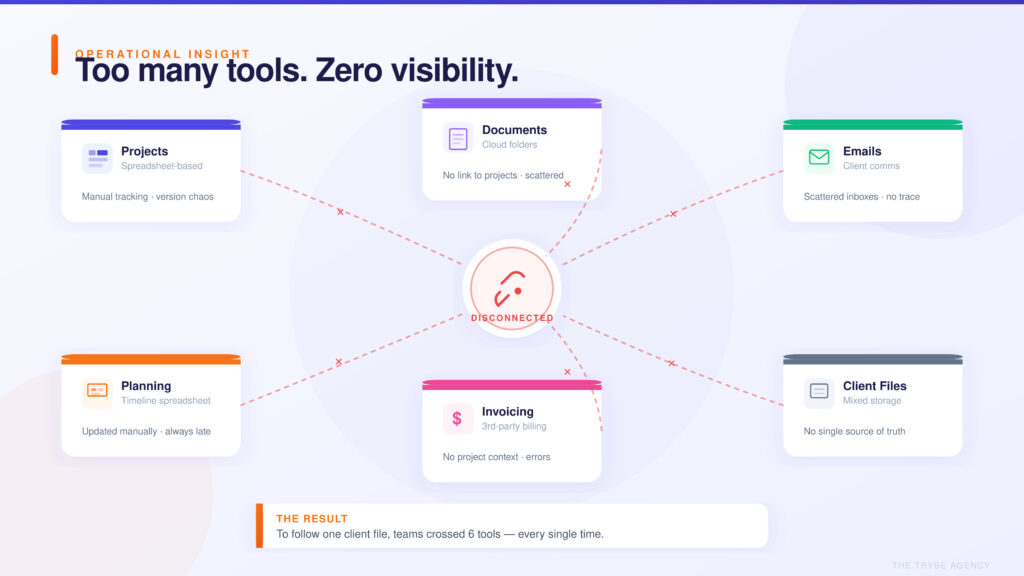
Projects in one place. Documents in another. Planning on a spreadsheet. Invoicing in a separate system entirely.
To follow a single client file from start to finish, teams had to move between spreadsheets, emails, folders, and disconnected tools, pulling pieces together manually, every single time.
Nothing was broken, exactly. But nothing was connected, either.
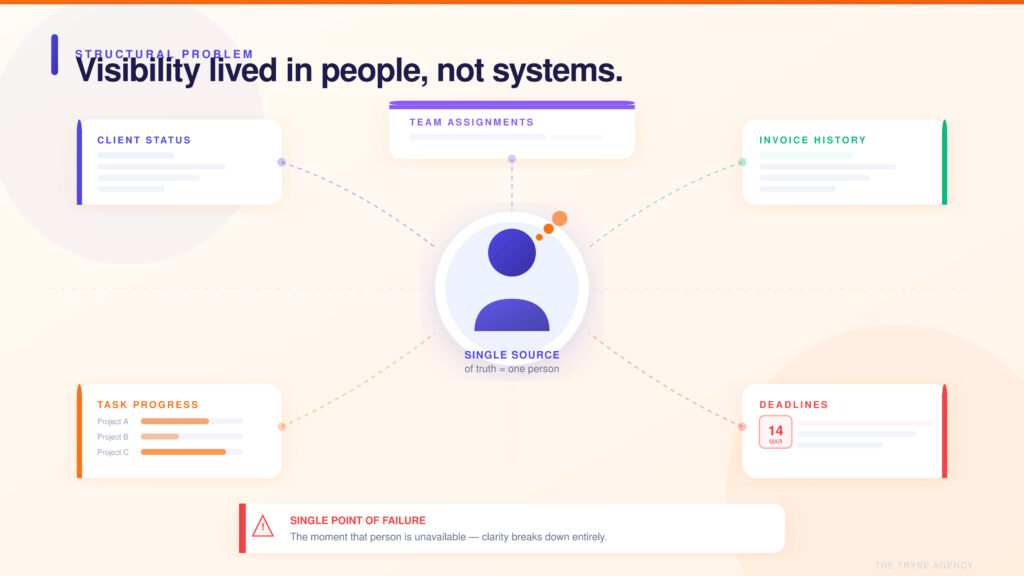
When there’s no single source of truth, information doesn’t disappear, it just lives in someone’s head.
That means visibility depends on who you ask, not on what the system shows. And the moment that person is unavailable, stretched thin, or simply doesn’t have the full picture, clarity breaks down.
That’s not a people problem. That’s a structural one.
Growth exposed the cracks.
More clients = more files. More files = more complexity. More complexity = less control.
What worked at a smaller scale became unsustainable. Coordinating across tools took longer. Errors crept in. Managers spent more time chasing status than making decisions. And the operation was harder to steer.
When this Canadian financial consulting firm came to us, the challenge wasn’t technical. It was structural.
How do you take an operation with highly specific workflows, multi-variable invoicing logic, and strict compliance requirements, and turn it into one clear, usable system that people actually want to use every day?
That was the question we set out to answer.
We designed and developed a fully custom web platform built around how the firm actually works, not how an off-the-shelf tool assumes they should.
In one place: workflows, task management, documents, Gantt-style planning, automated invoicing, collaborator roles, and real-time dashboards.
No more assembling the picture from five different sources. The system holds it all.
The shift was straightforward and significant.
Instead of switching between tools to manage a single file, teams could handle the full operation from one unified interface. Onboarding triggered the right workflow automatically. Tasks generated in sequence. Invoices fired at the right stage without manual input. Documents were centralized, versioned, and searchable.
The process stopped depending on people to hold it together. The system did that now.
Better visibility: managers could see every project’s status in real time, without asking anyone.
Better coordination: tasks, documents, planning, and invoicing moved in sync, not in parallel.
Better traceability: every action logged, every document versioned, every invoice tracked. Critical for a firm working in the fiscal and compliance space.
Better control: when business logic lives in the system, operations become consistent, predictable, and resilient.
Operations went from scattered across tools to a centralized system the team actually relies on.
Manual coordination gave way to automated workflows. Fragmented visibility gave way to real-time dashboards. And growth became something the platform could absorb.
That’s what happens when you stop managing your operation around your tools, and start building tools around your operation.

nationalcasinologin
added comment 4 weeks ago
Fast loading times and a very secure feeling. It is great to have a reliable login portal that actually works on mobile without lagging. nationalcasinologin is the way to go.
Free Porn Pics
added comment 4 weeks ago
ya,im here
uhumefefvd
added comment 1 months ago
lgnwwtnjiluxyppevhksosmpeklxpg
333985
added comment 3 months ago
wish you all the best
qtlvuhsvyn
added comment 3 months ago
ttfvliozksxjilhnylezmrmslowfzd
sevenbetcasino
added comment 3 months ago
Alright, so I've been messin' around on sevenbetcasino. Not gonna lie, they've got a decent selection and the layout is easy to navigate. Give it a whirl if you're lookin' for something new: sevenbetcasino
solairecasino
added comment 4 months ago
Solairecasino is the bomb, yeah? It's got style. I've seen some big wins there, and the vibe is always good. If you want something upscale, This is your place. You will find all kind of games. See for yourself at solairecasino.
